 curve.fi
Curve.fi fees and Total Transaction Costs
Curve.fi fees vary with the pool, its balances, and the action, while network gas adds a separate transaction cost. Compare the quoted output with the gas required for approvals and execution. A lower trading percentage alone does not establish which available option costs less overall.
Bottom line: A lower pool fee can still leave you with less value after gas if the route returns fewer tokens or requires more costly transactions.
Approval requirements and transaction type change the bill
An action requiring a separate token approval carries an additional network cost before the swap or liquidity transaction can proceed. An existing sufficient allowance can remove that requirement for the same token and spender. This difference can explain why otherwise similar transactions have different total costs.
Separate token approvals
A token approval authorizes a contract to spend an amount of that token. It does not perform the exchange. The approval amount describes spending permission, so it should not be read as a fee. Check the spender as well as the amount: an allowance for one contract does not automatically authorize another.
An approval transaction has its own gas estimate and receipt. Include its actual cost when calculating what the complete operation cost.
Swaps and liquidity transactions
A swap, liquidity deposit, and withdrawal execute different contract operations. Their gas requirements can therefore differ even when the assets have similar values. Curve supports separate approval checks and gas estimates for its supported operations. Compare the complete action you intend to perform, including any helper contract or additional transaction it requires.
Quotes and receipts account for different amounts
A quote describes expected token output before execution; a transaction receipt records what happened after inclusion. Neither alone describes every cost. Pool information supplies fee parameters, the output quote reflects the exchange calculation, and the wallet estimates the network charge for the prepared transaction.
Trading costs inside the output
Curve pool quote calculations deduct applicable trading fees when calculating the returned token amount. Subtracting the same fee again from that net output would count it twice. Price impact also affects the exchange result because the trade changes pool balances. It is an execution effect, rather than a separate payment shown on the network receipt.
Slippage tolerance sets the permitted deterioration from a quote. Raising it does not reduce the trading fee or improve the quoted exchange rate.
Network charges outside the output
The included transaction record identifies execution status, gas consumption, and the effective gas price. Token transfer records help establish the assets sent and received. Use records for the correct network and transaction, including separate approvals. A wallet balance change can also include unrelated activity, so it is less precise than matching the relevant transactions.
For an ordinary Ethereum transaction, execution gas cost equals gas used multiplied by the effective gas price. Other networks can include additional fee components. Keep those components in the total rather than applying one execution-only calculation everywhere. Convert gas and token amounts into a common unit only when comparing their values, using the same valuation basis for both options.
Pool imbalance changes the trading charge
Pool configuration and balances can change the applicable trading charge even when the input amount stays constant. StableSwap NG increases its dynamic fee with greater imbalance between the relevant value-adjusted balances when its off-peg multiplier enables that adjustment. The configured base fee therefore need not equal the effective fee for a particular exchange. A quote for the selected amount incorporates the applicable calculation; a remembered percentage cannot replace it.
A higher wallet estimate needs a matched comparison
If the wallet estimate exceeds the cost expected from the pool fee, first establish whether both displays describe the same thing. A pool percentage and a network charge measure different costs. The expected output, approval requirement, and prepared transaction should all correspond to the intended action.
Before signing, check the approval, network, quote, and transaction limits:
- If the wallet requests an approval, identify its spender and include its gas separately from the later exchange.
- If the network or selected operation differs, restore the intended selection before comparing estimates.
- If the output or route has changed, refresh the quote for the same input and output assets.
- If a displayed amount is a maximum network charge, distinguish that ceiling from the estimated charge.
- If the complete estimate remains acceptable and matches the intended transaction, confirm that its minimum output is also acceptable before signing; otherwise, leave it unsigned.
These checks do not require another paid transaction. After execution, the included receipt and actual token movements establish the amount paid and received. Reconcile those records before submitting another action to address an apparent discrepancy.
Liquidity entry and exit use different fee calculations
A liquidity transaction changes pool ownership and balances, so its cost cannot always be inferred from the displayed swap percentage. The deposit mix or withdrawal method matters alongside gas. Compare the assets committed with the pool shares or assets returned, rather than treating every liquidity action as an ordinary exchange.
Deposits with an uneven asset mix
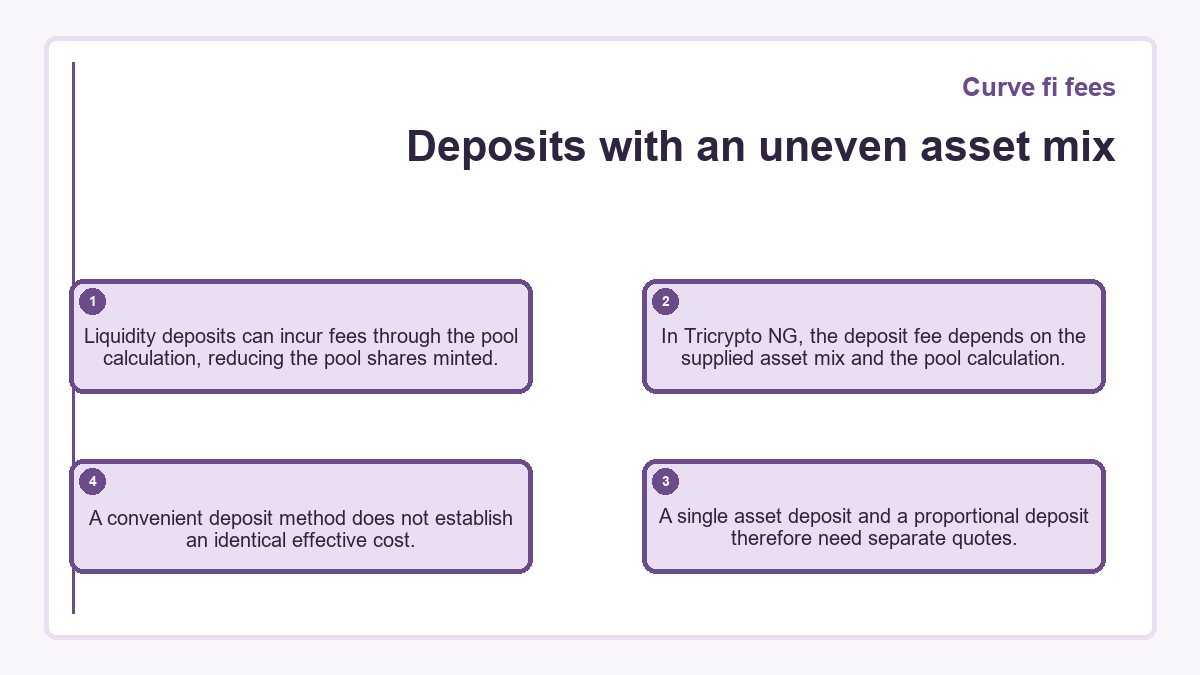
Liquidity deposits can incur fees through the pool calculation, reducing the pool shares minted. In Tricrypto NG, the deposit fee depends on the supplied asset mix and the pool calculation. A single asset deposit and a proportional deposit therefore need separate quotes. A convenient deposit method does not establish an identical effective cost.
Proportional and single asset withdrawals
StableSwap NG proportional withdrawals return assets in the pool’s current proportions without a withdrawal trading fee. Network gas still applies. Single asset and imbalanced withdrawals use fee-bearing calculations. If the desired endpoint is one asset, compare that withdrawal with proportional withdrawal plus any required exchanges. The latter introduces additional trading and execution costs, so the initial fee difference cannot settle the comparison.
Route savings depend on output after network costs
When two supported routes exchange the same input for the same output asset, compare their quoted output after accounting for network costs. A route returning more tokens can require more gas. It wins on estimated cost only if the additional output is worth more than the additional network charge, with any new approvals included.
The comparison needs matching inputs. Use the same amount, network, output asset, and valuation basis, with quotes close enough in time to remain meaningful. Route length alone does not establish a winner: intermediate pools can improve the exchange rate while adding fees and contract work. The available liquidity determines whether that trade-off helps.
You control the amount, supported route selection, and whether to accept a quote. Other transactions can change pool balances and network demand before execution. Waiting may reduce gas, but it also leaves the exchange price exposed to movement. Compare the refreshed total with executing now, rather than assuming that a later transaction will necessarily cost less.
Curve.fi fees questions, answered
What happens to gas charges when a Curve transaction reverts?
An included transaction that reverts still pays for the gas it consumes. The failed call reverses its state changes, but the network has performed execution work. A rejected wallet request or an unsubmitted transaction is different because it never enters on-chain execution.
Is the admin fee an additional percentage of my entire swap?
The pool admin fee represents a share of the trading fee, rather than another percentage charged against the entire swap amount. Do not add its displayed percentage directly to the trading percentage. The applicable allocation depends on the pool implementation and parameters.
Can I reduce transaction costs by lowering the gas limit?
Lowering the gas limit does not reduce the computation the transaction requires. Unused gas allowance does not become an extra charge. Setting the limit below the execution requirement can cause an out-of-gas failure and consume the provided gas without completing the action.
Does splitting a swap always make its total fee smaller?
Splitting a swap does not guarantee a lower total cost. Each included transaction adds network costs, and later swaps encounter the balances earlier swaps leave behind. Separate smaller quotes against an unchanged pool do not represent the combined result of executing those swaps sequentially.
Do I pay gas each time I refresh a Curve quote?
An ordinary read-only quote request does not charge your wallet an on-chain gas fee. Reading a contract calculation differs from submitting a transaction that changes its state. A wallet request to approve spending or execute an exchange is a separate action.
Will reversing a swap return the original amount after fees?
A reverse swap is another exchange with its own fee and output calculation. It encounters the pool balances present when it executes, including changes from the first swap and other activity. It is therefore not a refund of the original transaction or its network charge.
Why can the displayed cash value of a transaction fee change afterward?
A cash-denominated fee display can change when the price used to value the network token changes. That does not alter the settled fee recorded in native token units. For a consistent historical comparison, retain the actual network charge and use the same valuation time for every transaction.