 curve.fi
Curve.fi Liquidity, Swaps, and Lending Limits
Curve.fi connects token swaps, liquidity provision, and collateral-backed borrowing through pools and lending markets with different liquidity requirements. Its StableSwap mechanism concentrates liquidity around closely related asset values, while CryptoSwap supports assets with independently moving prices. Swap output depends on available pool balances; borrowing also requires eligible collateral, available capacity, and an acceptable loan position.
A token exchange ends with a changed wallet balance. Providing liquidity or opening a loan creates a position with continuing exposure. Understanding those different outcomes helps separate an executable transaction from a position whose withdrawal or repayment needs ongoing attention.
Bottom line: Swap depth, available lending liquidity, and collateral health impose different limits on what a Curve position can do.
Trading pools and lending markets as separate commitments
Curve trading pools hold assets users exchange against, while Llamalend markets connect suppliers of a borrowable asset with borrowers posting collateral. A swap transfers ownership of tokens. A liquidity deposit creates a claim on pool assets, and a loan creates debt secured by collateral. These functions share liquidity dependencies without creating interchangeable positions.
Curve also has crvUSD, a stablecoin targeting the value of the US dollar. Eligible borrowers can obtain it through collateralized minting markets, while other users can acquire it through trading. Lender-funded markets draw on supplied assets instead. The source of the borrowed asset matters because minting capacity and available lender deposits impose different constraints.
What determines the amount a Curve swap returns?
A Curve swap returns an amount determined by its route, trade size, pool balances, pricing algorithm, and applicable trading fees. Liquidity depth describes how much trading a pool can accommodate near a given price. The amount available in the desired output asset matters alongside the pool’s total value.
StableSwap supports assets expected to maintain a closely related value, including relationships adjusted for underlying yield. Its pricing becomes less favorable as a trade pushes balances further from equilibrium. CryptoSwap adjusts liquidity concentration for assets whose relative prices move. Neither mechanism creates an unlimited supply of the token being purchased.
Price impact describes the effect of the trade itself on execution prices. Slippage tolerance limits how far execution may deteriorate relative to the quote. The swap router searches supported routes, while a direct pool swap uses the selected pool. Trading fees affect the quoted exchange; network gas pays for transaction execution separately.
A swap decision before signing and after settlement
Consider a swap whose acceptable outcome is receiving at least a chosen minimum amount of the selected output token. Curve swaps enforce a minimum output amount and revert when execution cannot satisfy it. The quote changes with pool conditions, so the minimum must remain acceptable when the transaction goes to the wallet.
A missing spending allowance can prevent execution even when the wallet holds enough tokens. Before committing, use these conditions to decide whether the prepared swap matches the intended exchange:
- The selected network contains the intended input token and supported swap route.
- The wallet holds the input amount and enough native currency for required transactions.
- Any required token spending permission covers the intended contract and amount.
- The quoted output and transaction minimum both meet the intended exchange requirement.
- The receiving address matches the wallet meant to receive the output.
An unsigned swap can be revised or abandoned. A separately confirmed approval remains a permission even if the swap never follows. After successful settlement, compare the transaction’s input and output transfers with the starting wallet balances and chosen minimum. Account for gas separately. A reverted swap does not complete the exchange, although execution can consume gas. Reversing a completed swap requires another trade under new conditions.
Pool shares and exposure to changing balances
Liquidity providers deposit assets into Curve pools and receive liquidity provider tokens, usually called LP tokens, representing their share. Trading changes the assets behind that share. The position therefore differs from holding the original tokens untouched, even when its token balance stays constant.
Swap fees contribute to the pool position’s returns. Some pools also have incentives requiring participation in a gauge, a contract used to track eligible stakes and distribute rewards. Those incentives have separate conditions from trading income. A displayed reward rate does not establish what a position will earn over its holding period.
A stable asset losing its peg can leave providers increasingly exposed to the depreciating asset as traders remove stronger assets. Withdrawal methods also matter: taking a proportional share of pool balances differs from requesting a single asset. The available output and associated imbalance costs depend on the pool. LP tokens staked in a gauge require release from that stake for withdrawal.
Why can borrowing remain unavailable with enough collateral?
Borrowing can remain unavailable because a market lacks lendable assets, has reached its cap, or does not permit the requested collateral and debt combination. Collateral value alone cannot establish borrowing capacity. The market’s oracle, risk parameters, and existing position also constrain the amount it permits.
Llamalend uses isolated markets with their own collateral and borrowed asset. Legacy v1 lending markets require crvUSD on one side and are being phased out; v2 supports broader asset combinations subject to market configuration. A deployment or visible supply option does not prove borrowing is enabled. A market with a zero borrow cap cannot open borrowing until that limit changes.
Interest increases an open loan’s debt over time. Lender-funded markets use utilization, the proportion of supplied assets borrowers have taken, to determine rates. crvUSD minting markets use monetary policy connected to stablecoin conditions. A rate displayed when opening a loan is not a fixed rate for its entire duration.
LLAMMA conversions and the limits of recovery
LLAMMA, the Lending-Liquidating Automated Market Maker Algorithm, places collateral across price bands and supports gradual conversion into the borrowed asset as prices enter the liquidation range. This mechanism changes the composition of collateral during market movement. A position can contain both collateral and the borrowed asset.
Price recovery can reverse part of those conversions, but repeated movement through the bands can accumulate losses. An improving collateral price does not necessarily restore the original position or improve loan health.
Loan health measures the position’s remaining margin against hard liquidation under the market’s rules. Conversion losses and growing debt can weaken that margin. The gradual mechanism therefore requires attention to both the collateral composition and the debt. Reading only the market price misses changes already occurring inside the position.
Recovery options depend on the position and contract version. Full repayment closes the debt, while ordinary partial repayment during liquidation does not automatically move the position outside its conversion range. Llamalend v2 adds a repay-and-shrink reset path unavailable in v1. A reset can move the remaining position out of the conversion range; it does not reimburse conversion losses already incurred.
Can lenders withdraw whenever they want?
Llamalend suppliers can withdraw when their market has enough unborrowed assets to fulfill the request. The absence of a scheduled lockup does not establish immediate access to the entire supplied balance.
Borrower interest accrues to suppliers through their share of the market. High utilization means more supplied assets support outstanding loans and less remains available for withdrawal. Repayments or additional supply can change that balance. Separate incentives may add rewards, but they do not supply the liquidity needed to redeem a lending claim. Market isolation also leaves each lender exposed to the collateral and liquidation performance of the chosen market.
crvUSD savings and collateralized pool positions
The scrvUSD savings vault provides a different use for crvUSD: depositors receive shares whose conversion value reflects allocated borrowing revenue. The underlying crvUSD remains in the vault rather than entering individual lending markets. This separates savings-vault exposure from choosing a specific borrower collateral market, while retaining exposure to crvUSD and the vault contracts.
Supported Curve LP tokens can also secure loans in Llamalend v2. The underlying pool position can continue accruing trading fees while backing debt. Eligibility remains specific to the lending market. Combining these functions adds borrowing and liquidation exposure to the pool’s existing asset risks; earning pool fees does not remove the obligation to repay.
CRV locking and governance commitments
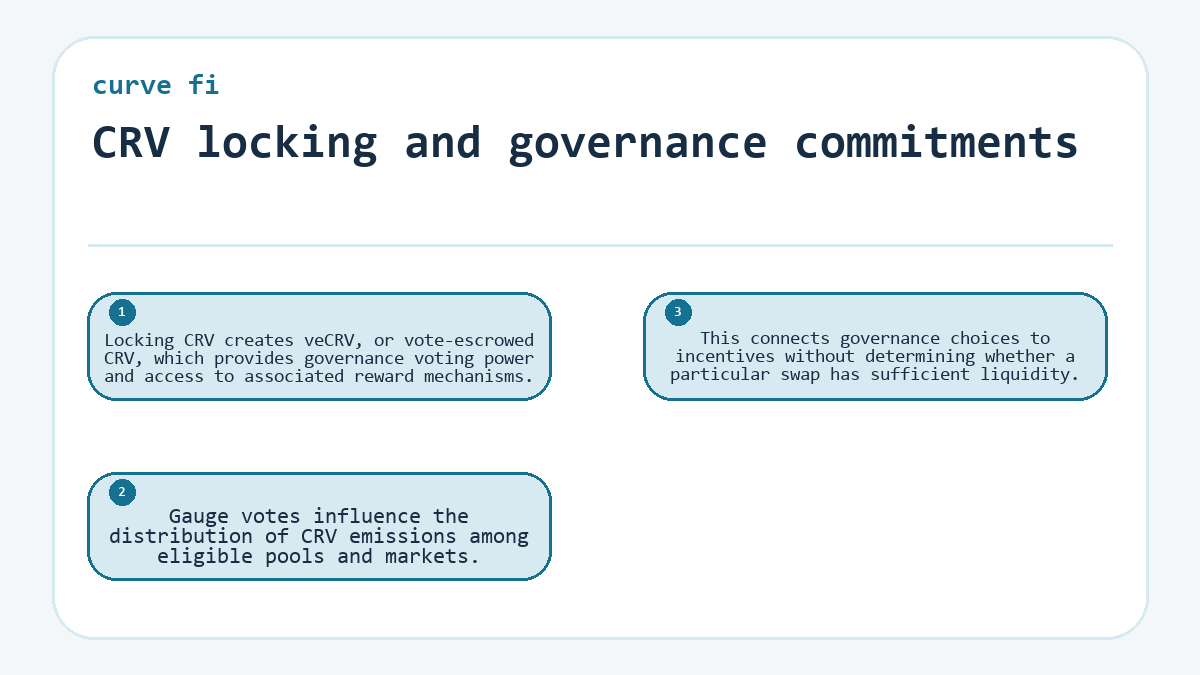
Locking CRV creates veCRV, or vote-escrowed CRV, which provides governance voting power and access to associated reward mechanisms. Gauge votes influence the distribution of CRV emissions among eligible pools and markets. This connects governance choices to incentives without determining whether a particular swap has sufficient liquidity.
veCRV is nontransferable, and its voting power declines as the lock approaches expiry. The locked CRV becomes withdrawable after the lock ends. Eligible liquidity positions may receive boosted CRV rewards, and veCRV holders can receive protocol revenue distributions. These benefits depend on the applicable contracts and position, so locking tokens creates a distinct commitment from depositing into a trading pool.
Contract dependencies and the next position choice
Curve positions depend on more than the visible interface. Trading pools depend on their assets and contract implementation. Lending adds oracle pricing, collateral liquidity, and debt accounting. Pool shares used as collateral combine those dependencies. A problem in an underlying asset can affect several positions even when their lending markets account for debt separately.
The intended exit helps distinguish the available actions. A token exchange needs an acceptable execution price. A pool position needs a suitable withdrawal form, while a lending claim needs available liquidity. Borrowing requires a repayment path and attention to changing health. Governance locking commits tokens until expiry. Choose the position whose continuing obligations match the intended use of the assets.
Details worth knowing about Curve.fi
Do I need CRV to swap on Curve.fi?
CRV ownership is not a prerequisite for an ordinary Curve swap. The transaction needs the selected input asset, any required spending allowance, and the network’s gas currency. CRV has separate roles in incentives and governance; acquiring it does not replace any of those transaction requirements.
Does connecting a wallet give a pool permission to spend tokens?
Connecting a wallet does not itself grant a token spending allowance. An approval authorizes a specified contract to spend a particular token within the allowance. That permission is separate from the swap transaction, and its scope depends on the approved spender and amount.
What happens to an approval after I disconnect my wallet?
Disconnecting a wallet from the interface does not revoke an onchain token allowance. The permission remains subject to the token contract’s allowance rules until spending reduces it or another transaction changes it. A disconnected interface and a revoked spending permission are different states.
Is buying crvUSD the same as opening a crvUSD loan?
Buying crvUSD through a swap does not create a collateralized loan for the buyer. Borrowing creates a debt position with interest and collateral requirements. Both actions can produce a crvUSD balance, but only the borrowing action creates that repayment obligation.
Can I lend assets through a crvUSD minting market?
A crvUSD minting market does not use a lender-funded vault to obtain the stablecoin it issues. Supplying assets for borrowers belongs to a lending market. The distinction matters when choosing where to deposit because the two market types have different funding mechanisms.
Are Curve transactions private?
Curve transactions on public blockchains expose onchain records, including participating addresses, token transfers, and contract interactions. A wallet address does not automatically reveal a person’s name, but its activity can connect multiple positions. The trading interface does not make those records confidential.
Will my scrvUSD token balance rise as savings revenue accrues?
Savings revenue generally increases the amount of crvUSD represented by each scrvUSD share, rather than increasing the number of shares held. A constant scrvUSD balance can therefore represent a changing underlying amount. The share conversion rate and the token’s market trading price are distinct values.
Can a Curve pool hold another pool’s LP token?
A Curve metapool can hold a base pool’s LP token as one of its assets. That token represents exposure to the underlying base pool, so the metapool adds another layer of pool dependencies. Its displayed assets do not necessarily describe every underlying asset exposure.